
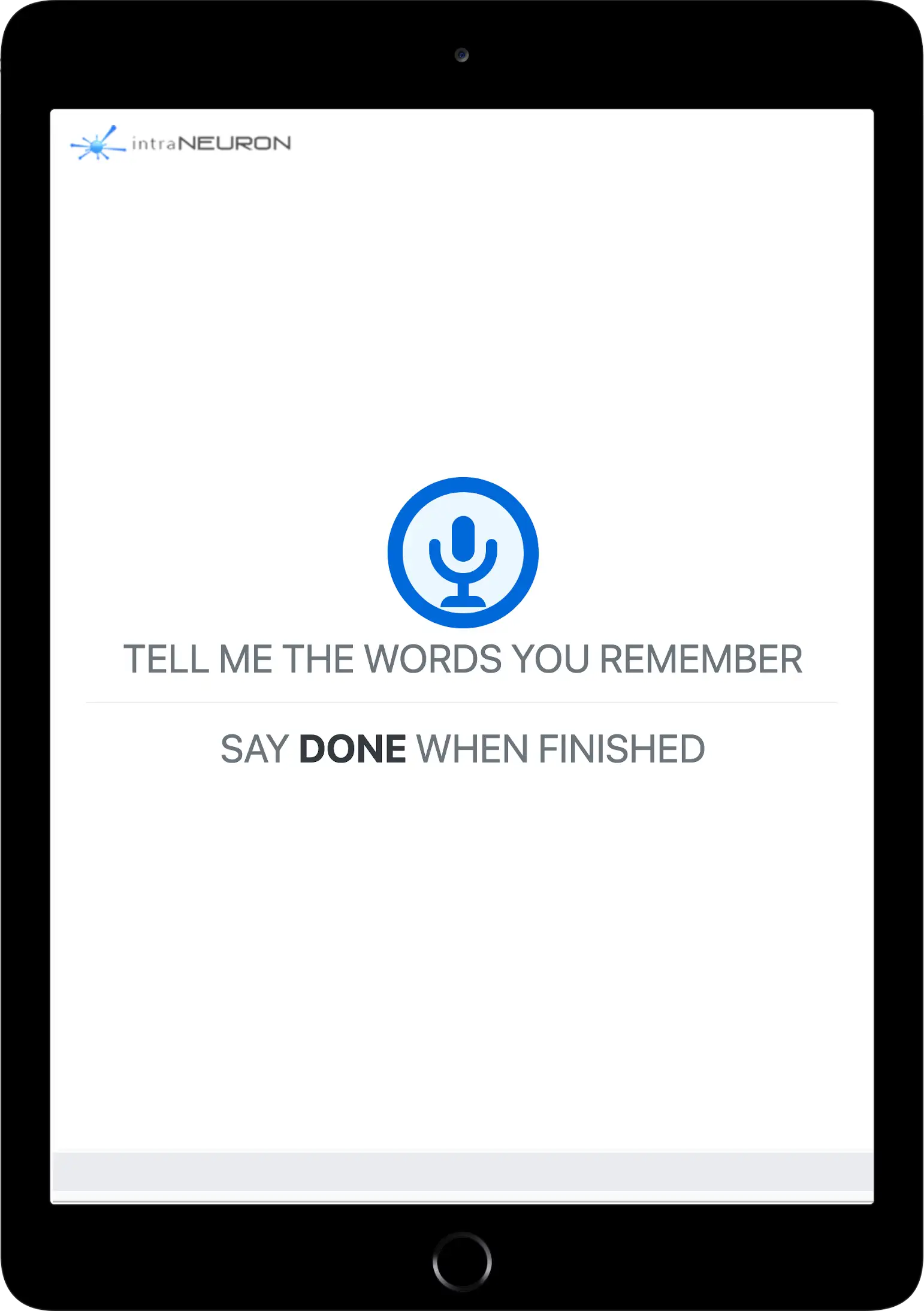
The exam is spoken. You hear the instructions aloud, and you answer out loud. Nothing is typed, nothing is clicked, and there is no writing to do.
It takes ten to fifteen minutes, start to finish, in one sitting.
Why voice
Verbal memory is one of the first things to change in mild cognitive impairment and Alzheimer's disease. Testing it properly means asking someone to listen, hold words in mind, and say them back, which is exactly what a clinical neuropsychologist does in person.
A written or multiple-choice quiz cannot do this. Recognising a word on a list is a much easier task than recalling it unprompted, and the easier task is the one that stays intact longest. That is why a test you can pass by pointing at the right answer tends to miss early change.
Speaking your answers also means the exam measures verbal fluency, how readily words come to you, which is difficult to capture any other way.
What happens during the exam
- A sound check. The exam confirms it can hear you before anything is scored.
- Listening and recall. You hear a set of words and say back the ones you remember. This repeats, so the exam can see how much you learn across attempts, not just what you retained on the first pass.
- Fluency. You name as many items in a category as you can within a short time.
- Delayed recall. Later in the exam you are asked for those words again, after your attention has been elsewhere.
The gap between what you learned and what you kept is often the most informative part of the whole exam.
How your answers are scored
Your spoken answers are transcribed by speech recognition built for this purpose, then scored against normative data, which is what people of your age and educational background typically achieve.
That comparison is the point. A raw number of words recalled means very little on its own. The same score can be entirely expected at 78 and worth a conversation at 52.
The technology is covered by United States patents 11,547,345 and 12,226,221, and the approach has been evaluated against standard neuropsychological assessment in peer-reviewed research.
What you need
- A phone, tablet or computer with a microphone and speakers
- A current browser. Chrome, Edge, Safari and Firefox are all verified
- A quiet room, because background noise interferes with recording your answers
- Ten to fifteen minutes when you will not be interrupted
No app to install, and no special hardware. Headphones are fine but not required.
What it is not
The Memory Exam is a screening test, not a diagnosis. It can tell you whether your performance is typical for someone like you. It cannot tell you why it is not, and no screening test can.
If your results suggest a change, take them to your doctor. That is what they are for.